A Clock that Displays the Actual Local Time
You might be wondering what that's all about: a watch that displays the actual local time. Doesn't every watch or clock do that? The answer is “no.”
Local Solar Time
For centuries, sundials have been used to tell the time: the shadow cast by a gnomon on a scale moves steadily throughout the day, from sunrise to sunset. Noon was always when the sun reached the highest point in its path across the sky and each town had it's own local time, the local solar time. Why was this a "local" time? Because the Earth rotates 15° per hour, each degree of longitude corresponds to about 4 minutes of time difference. Thus, in a city that lies 1 degree of longitude further east, noon is 4 minutes earlier, while in a city that lies 1 degree of longitude further west, noon is 4 minutes later. This worked reasonably well when people traveled slowly by horse or ship.
At some point, however, a problem arose: the railroad and the telegraph were invented. This changed everything. A train could travel hundreds of kilometers in a day, passing through many towns, each with its own local time. Now timetables became confusing, departure and arrival times were difficult to compare und scheduling connections was very complicated. Furthermore the risk of collisions on single-track railways increased.
The telegraph made the situation even more urgent. For the first time, information could travel almost instantaneously over long distances. Imagine sending a telegram from London to Liverpool: A message sent at 12:00 might appear to arrive in Liverpool at 11:48 , thus before it was sent according to local clocks.
Time Zones
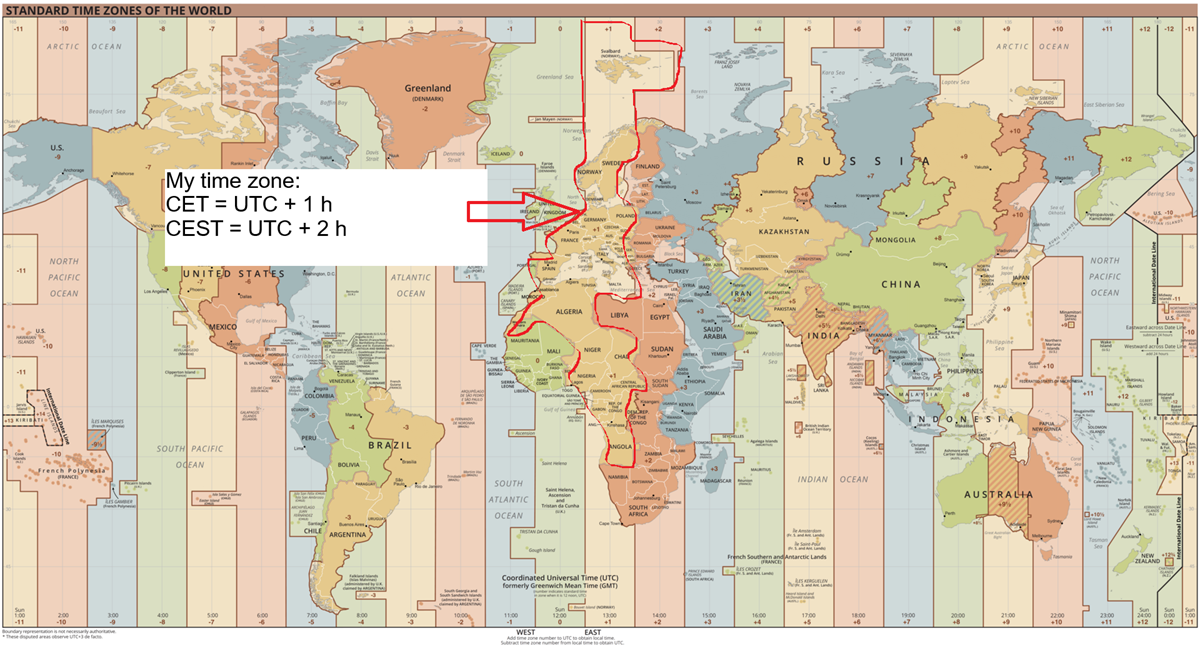
To solve this problem, time zones were introduced: now, instead of every location having its own time, all locations within a defined time zone use the same time. Where I live, "Central European Time (CET)" applies, or "Central European Summer Time (CEST)" during the summer. Central European Time (CET) and Central European Summer Time (CEST) are the standard and daylight-saving time systems used in much of Europe. Does that mean it's really noon when my watch says 12 o'clock? No, unfortunately not at all.
It should be clear now that CET does not represent the local solar time of any particular city or my home. Instead, it represents the mean solar time at the central meridian of the time zone, which is in case of the CET und CEST 15 ° East. So I don't actually live at 15 degrees longitude, but at 12.9° East longitude. That means the difference due to the longitude deviation alone is already over 8 minutes. But the even greater difference compared to CET is that in Central Europe, clocks are set forward another full hour in the summer. This means I have a time difference of at least 8 minutes, so my clocks are always ahead relative to the sun.
All right, no problem: I'll just set the clock forward about 8 minutes, and then I'll have the correct local time, right? In the summer, I'll just have to adjust it by one more hour. Unfortunately, it's even more complicated than that: now the so-called “Equation Of Time” factor comes into play
Equation Of Time
The equation of time isn't that easy to understand: Suppose I had a very accurate mechanical watch and set it exactly to 12 noon, when my sundial shows exactly 12 o'clock. Then my mechanical watch should show the exact local time all year round, since it was set precisely according to the sun. Unfortunately, that's not the case. In this instance, it's the sundial that doesn't run quite evenly throughout the year. How could this be? The Equation of Time arises from two physical effects:
Earth's Orbit Is Not Circular
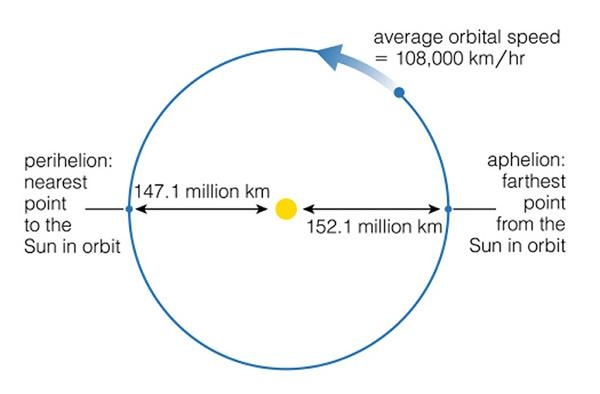
The Earth travels around the Sun in an elliptical orbit rather than a perfect circle. According to Kepler's Second Law, the Earth moves faster near perihelion (early January) and slower near aphelion (early July). As a result, the apparent motion of the Sun across the sky is not uniform throughout the year.This effect contributes roughly ±7.5 minutes to the Equation of Time.
Tilted Earth Axis
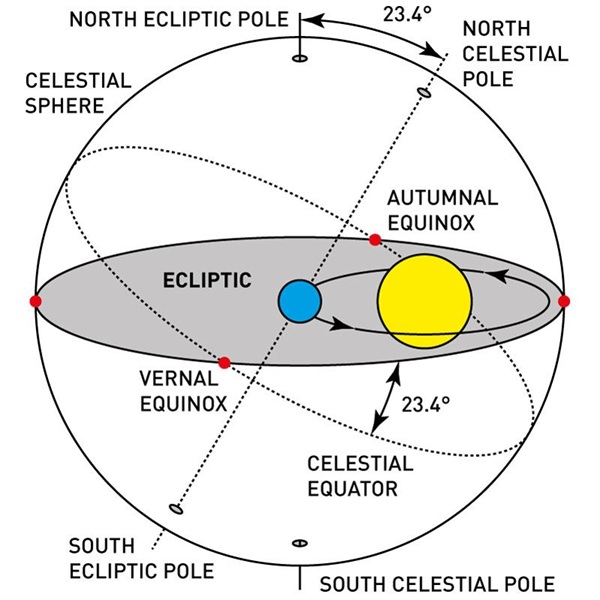
The Earth's rotational axis is tilted by approximately 23.44° relative to its orbital plane. Because of this tilt, the Sun appears to move along the ecliptic rather than along the celestial equator. Consequently, the Sun's apparent daily motion projected onto the equatorial coordinate system is not constant. This effect contributes roughly ±10 minutes to the Equation of Time.
Resulting Time Difference
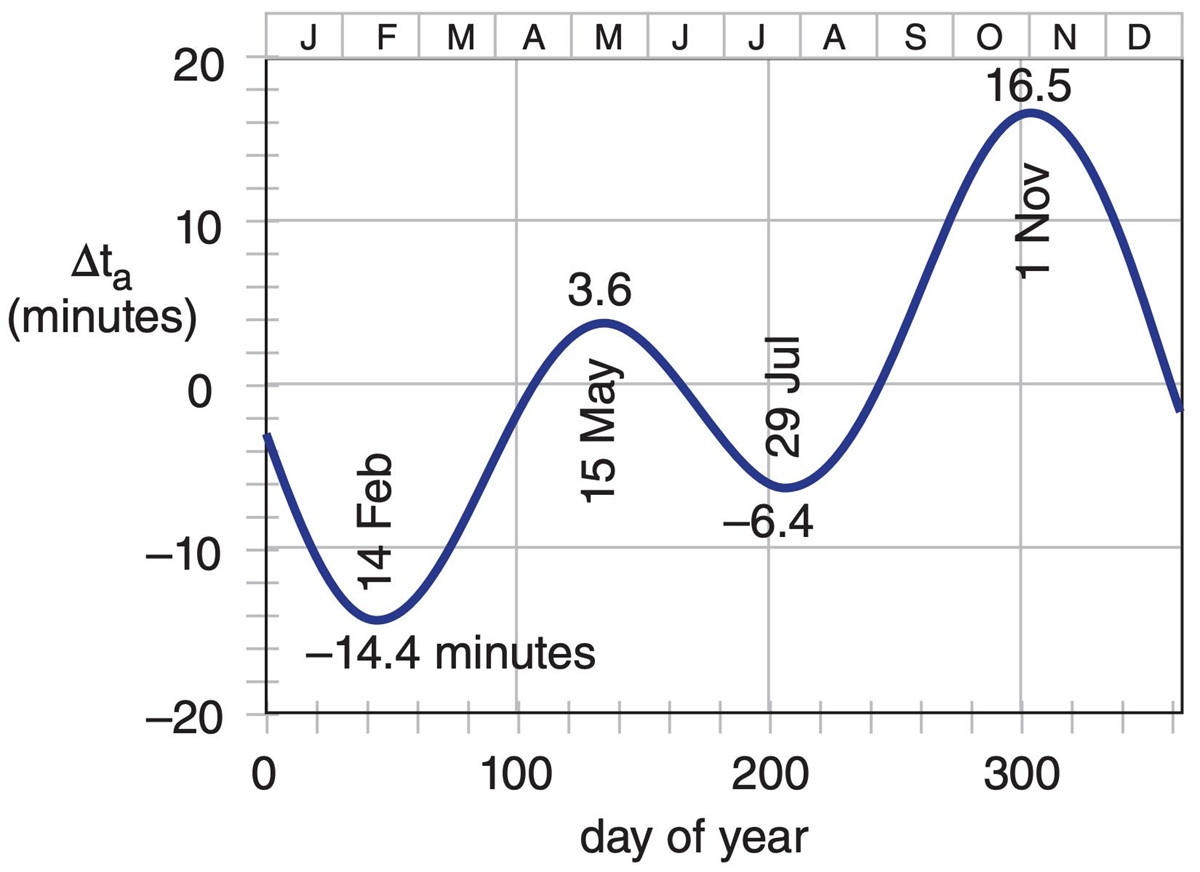
Since these two effects overlap, the result is a deviation of the mean local time from the true local time that varies throughout the year. The largest deviations occur in April and November, at -14.4 min and +16.5 min, respectively.
Approximation Formula
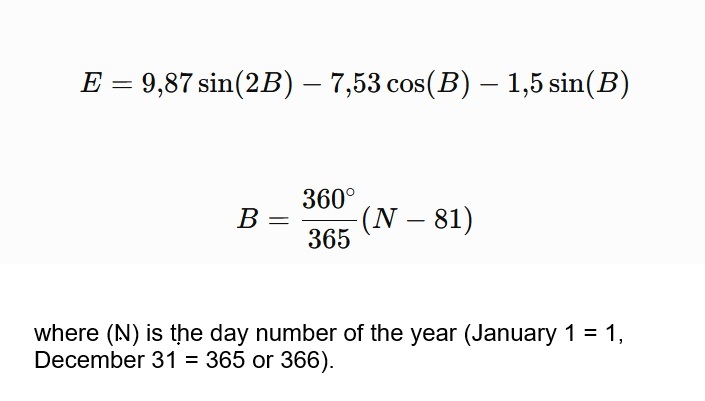
Implementing a program for a clock that displays the true local time is very simple once you have a mathematical description of the Equation Of Time. The challenge now is to find a formula that provides the best possible approximation of the time difference one. Fortunately, there are already several formulas that describe these time differences with good mathematical precision.
Meaning of the Individual Terms
B = (360/365)*(N - 81)
This converts the day of the year into an angle ranging from 0° to 360°. Day 81 is close to the March equinox.
9.87 * sin(2B)
This term mainly represents the effect of the Earth's axial tilt. Why does it contain sin(2B)? The influence of the tilt repeats twice per year: Around the March equinoxand around the September equinox, therefore, the variation has a frequency of (2B).The coefficient 9.87 means that this component can contribute up to +/- 9.87 minutes.
-7.53 * cos(B)
This term primarily represents the effect of the Earth's orbital eccentricity. Since the Earth completes one orbit per year, a single annual frequency (B) is sufficient. Its maximum contribution is approximately +/- 7.53 minutes
-1.5 * sin(B)
This smaller correction term improves the fit to the actual Equation of Time curve. It accounts for interactions between the two main effects and reduces the overall approximation error. Why These Particular Numbers? The coefficients (9.87, 7.53 and 1.5) are not directly derived from celestial mechanics. Instead, they come from curve fitting. Astronomers calculated the true Equation of Time and then approximated it using a combination of sine and cosine functions. The coefficients were chosen to produce the best fit over the ourse of a year.
Connection to the Analemma
If you photograph the Sun at exactly the same clock time every day for a year, the resulting pattern is called the analemma. The analemma forms a figure-eight shape in the sky.
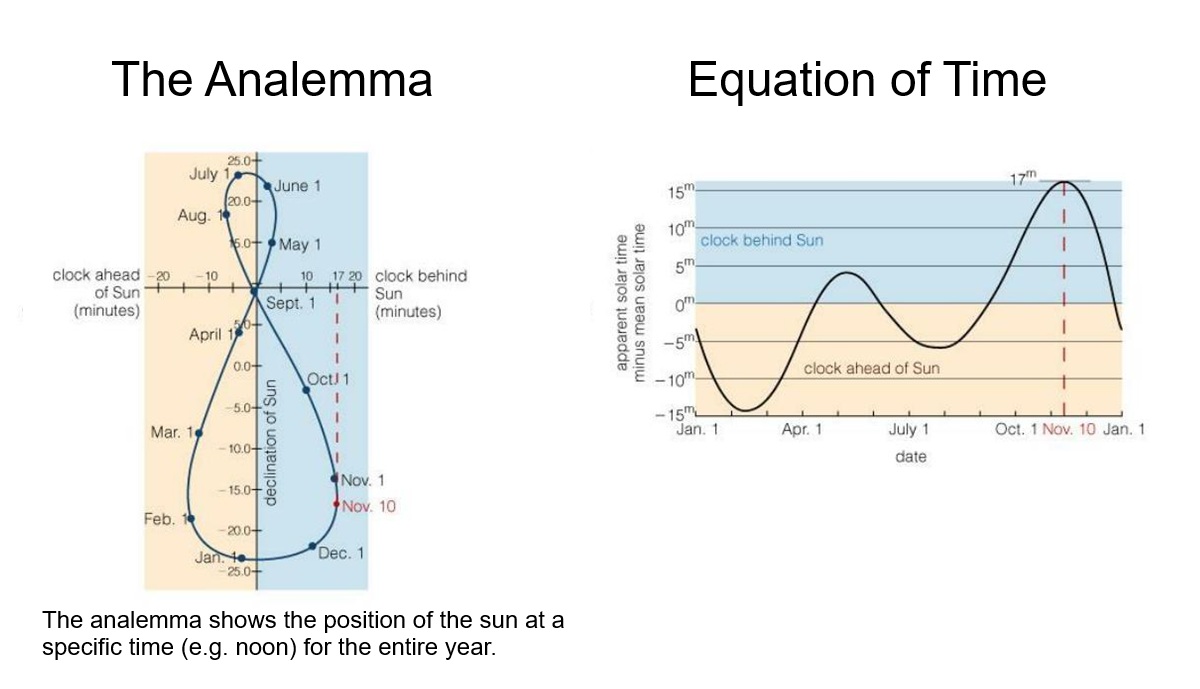
The left-right displacement corresponds to the Equation of Time. The up-down displacement results from the seasonal change in the Sun's declination. For this reason, many astronomical clocks include either an Equation of Time indicator, or an analemma display.